DevOps is about Developing a Change Application System

As the DevOps movement rolls on, there is a pattern emerging. Some efforts are initiated by development, seeking relief on test environment management. Others are initiated by operations departments trying to get more automation and instrumentation into the environments they manage. I frequently hear comments that are variations on “same stuff I’ve been doing for xx years, different title” from people who have DevOps in their job title or job description. Their shops are hoping that if they encourage folks to think about DevOps and maybe try some new tools, they will get the improvements promised by DevOps discussions online. Well, just like buying a Ferrari and talking it up won’t make you Michael Schumacher, having Puppet or Chef to do your configuration management won’t “make you DevOps” (whatever that means). Successful DevOps shops are bypassing the window dressing and going at DevOps as a project unto itself.

There are a number of unique aspects to undertaking a project such as this. They require a holistic perspective on the process, touch a very broad range of activities, and provide an approach for changing other systems while being constantly changed themselves.

These projects are unique in the software organization because they require a team to look at the whole end-to-end approach to delivering changes to the application systems within that organization FROM THE SIDE; rather than from a position somewhere in the middle of the process. This is an important difference in approach, because it forces a change in perspective on the problem. Typically, someone looking from either the development or the operations “end” of the process will often suffer from a perceptive problem where the “closer” problems in the process look bigger than the ones “farther” up or down the process line. It is a very human thing to be deceived by the perspective of our current position. After all, there are countless examples of using perspective for optical illusions. Clever Leaning Tower of Pisa pictures (where someone appears to be holding it up) and the entire Lord of the Rings movie trilogy (the actors playing the hobbits are not that short) provide easy examples. Narrowness of perspective is, in fact, a frequent reason that “grassroots” efforts’ fail outside of small teams. Successfully making large and impactful changes requires a broader perspective.

The other breadth-related aspect of these programs is that they touch a very wide range of activities over time and seek to optimize for flow both through and among each. That means that they have some similarities with supply chain optimization and ERP projects if not in scale, then in complexity. And the skills to look at those flows probably do not exist directly within the software organization, but in the business units themselves. It can be difficult for technology teams, that see themselves as critical suppliers of technology to business units, to accept that there are large lessons to be learned about technology development from the business units. It takes a desire to learn and change at a level well above a typical project.

A final unique part is that there must be ongoing programs for building and enhancing a system for managing consistent and ongoing changes in other systems. Depending on your technology preference, there are plenty of analogies from pipelines, powergrids and aircraft that apply here. Famous and fun ones are the flight control systems of intrinsically unstable aircraft such as the F-16 fighter or B-2 bomber. These planes use technology to adjust control surfaces within fractions of a second to maintain steady and controled flight within the extreme conditions faced by combat aircraft. Compared to that, delivering enhancements to a release automation system every few weeks sounds trivial, but maintaining the discipline and control to do so in a large organization can be a daunting task.

So the message here is to deliberately establish a program to manage how changes are applied. Accept that it is going to be a new and unusual thing in your organization and that it is going to require steady support and effort to be successful. Without that acceptance, it will likely not work out.

My next few posts are going to dig into this deeper and begin looking at the common aspects of these programs, how people approach the problem, how they organize and prioritize their efforts, and the types of tools they are using.
DevOps is NOT a Job Title

Given my recent posts about organizational structure, I feel like I need to clarify my stance on this…

You know a topic is hot when recruiters start putting it in job titles.  I do believe that most organizations will end up with a team of “T-shaped people” focused on using DevOps techniques to ensure that systems can be support an Agile business and its development processes.  However, I am not a fan of hanging DevOps on the title of everyone involved.

Here’s the thing, if you have to put it in the name to convince yourself or other people you are doing it, you probably are not.  And the very people you hope to attract may well avoid your organization because it fails the ‘reality’ test.  In other words, you end up looking like you don’t get it.  A couple of analogies come to mind immediately.

  • First, let’s look at a country that calls itself the “People’s Democratic Republic of” somewhere.  That is usually an indicator that it is not any of those modifiers and the only true statement is the ‘somewhere’ part.  Similarly, putting “DevOps Sysadmin” on top of a job description that, just last week, said “Sysadmin” really isn’t fooling anyone.
  • Second, hanging buzzwords on job titles is like a 16 year old painting racing stripes on the four door beater they got as their first car.  With latex house paint.  You may admire their enthusiasm and optimism.  You certainly wish them the best.  But you have a pretty realistic assessment of the car.

Instead, DevOps belongs down in the job description.  DevOps in a job role is a mindset and an approach used to define how established skills are applied.  You are looking for a Release Manager to apply DevOps methods in support of your web applications.  Put it down in the requirements bullet points just as you would put things like ‘familiar with scripting languages’, ‘used to operating in an [Agile/Lean/Scrum] environment]’, or ‘experience supporting a SaaS infrastructure’.

I realize that I am tilting at windmills here.  We went through a spate of “Agile” Development Managers and the number of  “Cloud” Sysadmins is just now tapering.  So, I guess it is DevOps’ turn.  To be sure, it is gratifying and validating to see such proof that DevOps is becoming a mainstream topic.  I should probably adopt a stance of ‘whatever spreads the gospel to the masses’.  But I really just had to get this rant off my chest after seeing a couple of serious “facepalm” job ads.

How a DOMO Fits

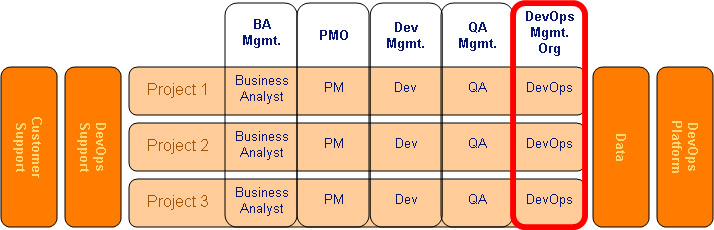
In my previous post, I discussed the notion of a DevOps Management Organization or DOMO.  As I said there, this is and idea that is showing up under different names at shops of varying sizes.  I thought I would share a drawing of one to serve as an example.  The basic structure is, of course, a matrix organization with the ability to have each key role present within the project.  It also provides for shared infrastructure services such as support and data.  You could reasonably easily replace the Business Analyst (BA) role with a Product Owner / Product Manager role and change “Project” to “Product” and have a variant of this structure that I have seen implemented at a couple of SaaS providers around Austin.

This structure does assume a level of maturity in the organization as well as the underlying infrastructure.  It is useful to note that the platform is designated as a “DevOps Platform”.  It would probably be better to phrase that as a cloud-type platform – public, private or hybrid – where the permanence of a particular image is low, but the consistency and automation is high.  To be sure, not all environments have built such an infrastructure, but many, if not most, are building them aggressively.  The best time to look at the organization is while those infrastructures are being built and companies are looking for the best ways to exploit them.

Organization with DOMO

“Enterprise” DevOps

Anyone in the IT industry today will note that much of the DevOps discussion is focused on small companies with large websites – often tech companies providing SaaS solutions, consumer web services, or some other solution content.  There is another set of large websites, supported by large technology organizations that have a need for DevOps.  These are large commerce sites for established retailers, banks, insurance companies, etc.  Many of these companies have had large-scale online presences and massive software delivery organizations behind them for well over a decade now.  Some of these enterprises would, in fact, qualify among the largest software companies on the planet dwarfing much more ‘buzz-worthy’ startups.  It also turns out that they are pretty good at delivering to their online presence predictably and reliably – if not as agilely – as they would like.

Addressing the agility challenge in an enterprise takes a different mindset than it does in a tech startup.  This has always been the case, of course.  Common sense dictates that solving a problem for 100 people is intrinsically different than for 10,000.  And yet so many discussions focus on something done for a ‘hot’ website or maybe a large ‘maverick’ team in a large organization.  And those maverick team solutions more often than not do not scale to the enterprise and have to be replaced.  Of course, that is rarely discussed or hyped.  They just sort of fade away.

It is not that these faded solutions are bad or wrong, either.  A lot of times, the issue is simply that they only looked at part of the problem and did not consider the impact of improving that part on the other parts of the organization.  In large synchronized systems, you can only successfully accelerate or decelerate if the whole context does so together.  There are many over-used analogies for this scenario, so let’s use the one about rowers on a boat to make this point and move on.

Let’s face it, large organizations can appear to be the “poster children” for silos in their organizational structure.  You have to remember, though that those silos often exist because the organization learned hard lessons about the value of NOT having someone maniacally focused on one narrow, specialized activity.  Think about this as your organization grows, runs into problems or failures, and puts infrastructure in place to make sure it doesn’t happen again.

One of the main points of this blog is going to be to look at the issues confronted by organizations that are or are becoming ‘enterprises’ and how they can balance the need for the Agile flexibility of DevOps with the pragmatic need to synchronize large numbers of people.